
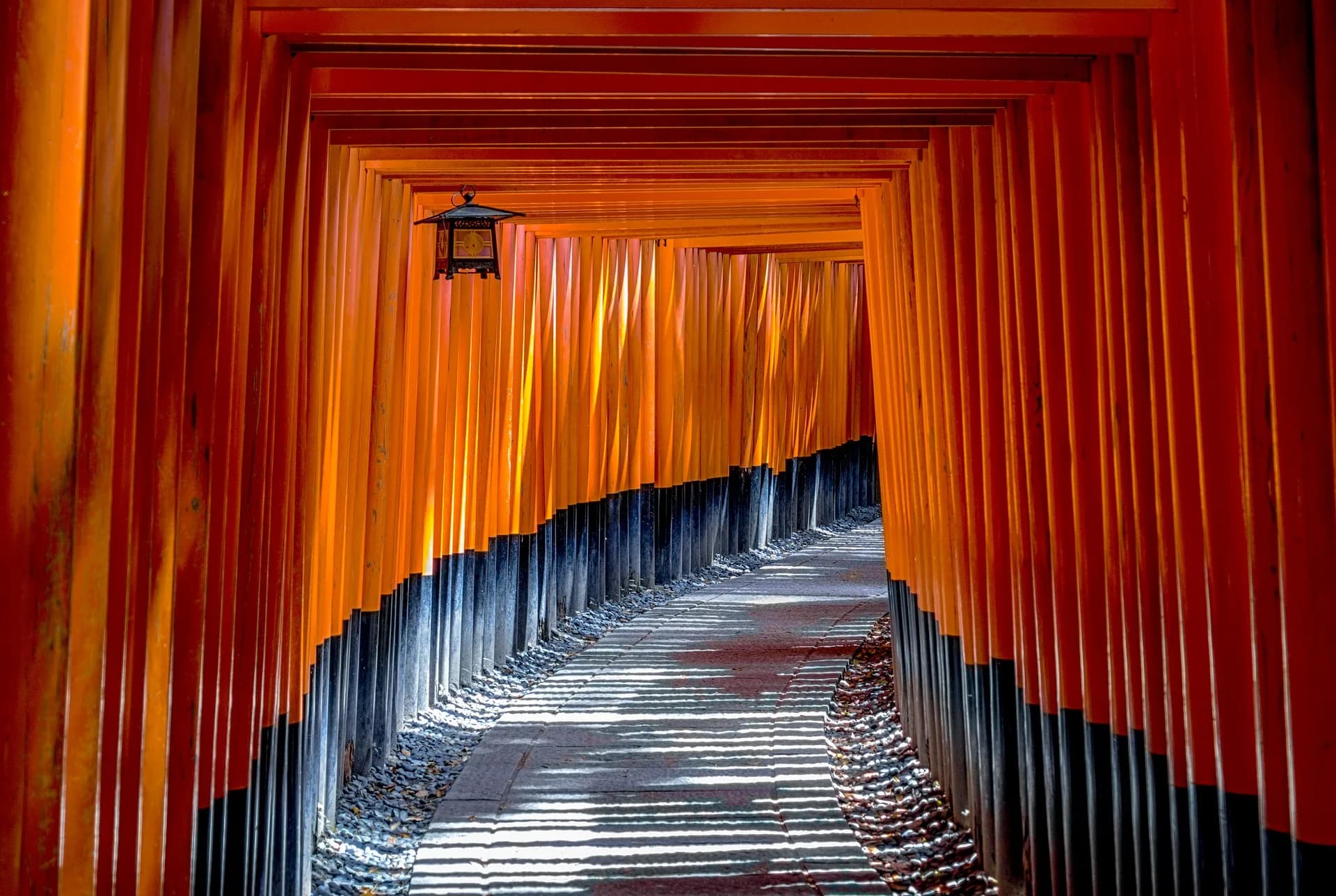
To get to know a kind and proud people, guardians of an ancient culture rich in fascinating traditions and rituals. A culture that goes hand in hand with modernity, innovation and the very highest level of technology.
The Japan we know from the cinema gives us contrasting images.
The countryside is calm and peaceful, with rice fields, temples and pagodas that seem frozen in time.
In the ultra-modern cities, on the other hand, there is a ceaseless swarm of traffic and people on foot or on bicycles. They live in ever smaller flats, where they often come home only to sleep after a day at work or at school.
Today many Italians travel to Japan often for study or work, or even live there. Some describe their experience on blogs and YouTube: how they adapted to a way of life different from ours, which you can start to discover (even before you leave) and become part of.
Ancient traditions such as the tea ceremony or ikebana evoke slowness and silence. They live side by side with the frenzy of working life, which has taken the Japanese to the top in technological progress and the world economy.
The Japanese are described as kind, formal, proud and very religious.
The cities are very orderly, public transport is extremely efficient, and shared spaces are clean and well kept.
The Japanese school system is different from ours: by going to school for a whole year you will also learn traditional arts, such as calligraphy, the tea ceremony and ikebana (the art of arranging cut flowers). You may be able to do judo or learn to wear a kimono, Japan’s traditional dress.
In Japan for a whole year
If you have chosen Japan for your school year abroad, it’s worth starting to study the language and local traditions straight away, because this will make it easier to make friends and fit in at school. Japan’s national public broadcaster offers Easy Japanese, a completely free online language course with videos, audio, exercises and tests, kept up to date.
But your first school will be your host family. With them you will learn to speak Japanese and to understand the rules of behaviour (for example, how to behave at the table or how to greet people). You will discover modern customs and ancient traditions.
In return, be ready to talk about the traditions of your country and your family’s habits, and remember what a privilege it is to get to know a new country from inside a family: it is “your” family that will make your year abroad special.
What to see in Japan
Whatever city you live in, you can count on an extensive transport network, and it will be easy to travel to visit others.
Among the modern cities there is first of all the capital, Tokyo (we recommend GO TOKYO for exploring it bit by bit, including its outskirts, waterfront and islands), and then Osaka, the third-largest city, considered the country’s commercial centre.
Nagoya, the country’s fourth most populous city, has more than two million inhabitants, almost as many as Rome, in an area four times smaller.
Kyoto and Nara, where you will see famous temples among the most evocative places in the world, have been declared World Heritage sites.
Other cities worth seeing are Kobe (for centuries one of Japan’s main ports) and Himeji, near Kyoto, where you can see the cherry blossom in spring.
Hiroshima is sadly famous, together with Nagasaki, because both were razed to the ground by the atomic bomb during the Second World War. In the Memorial Park there is a museum that tells the story of the city and the devastation the bomb caused.
Miyajima, whose name means “shrine island”, is famous for its red torii gate built on the water. Finally, the installations at Kanazawa’s museum of contemporary art are well worth a visit, such as Leandro Erlich’s The Swimming Pool, a pool you can step into fully dressed, and other interactive works.
Keep exploring
Find an experience that fits you
School abroad, volunteering or a short program — your next chapter starts with a conversation.
See the programs